The Fiver Test: One Note, One Market Town, Zero Chain Shops
The rules of the game
It began with a minor argument about whether a fiver is still real money. In 2026, with contactless taps and ominous supermarket self-checkouts, a £5 note can feel like a museum piece. So I gave myself a rule: one note, one market town, no chain shops. Whatever I could buy with five pounds from independents only, I would buy. Whatever I couldn't, I'd leave on the shelf.
I picked a bright Saturday in late October and a town I'll call Bellwether — a Shropshire-style market town with a square, a war memorial, and more dog bowls than cash machines. The real name doesn't matter. The rules do.
First stop: the bakery
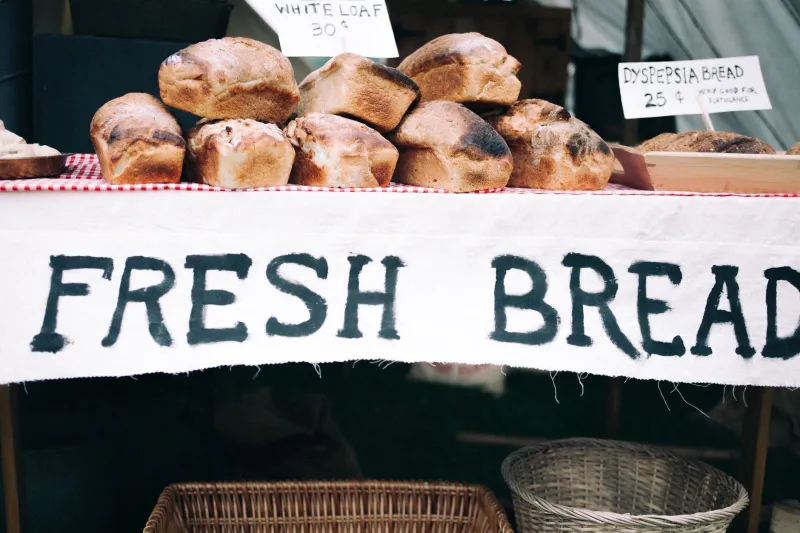
Hughes the Bakers had a queue out of the door and a window full of iced buns. I joined the queue, because in a market town the queue is usually the review. When I reached the counter, I asked for the smallest possible lunch: one sausage roll, please.
'Two pounds twenty,' said the woman behind the till, wrapping it in paper before I'd finished nodding. 'You'll want it warm. That's the last of the morning batch.'
I asked what a fiver means to her, now that everything seems to cost six. She laughed. 'It's a decent lunch,' she said. 'Not a treat. A lunch. There's a difference. People come in with a fiver and they want to leave with something that feels like a proper Saturday.'
That seemed like a good benchmark. A fiver should feel like a Saturday, not a rounding error.
The market stall
In the square, between a van selling plants and a table of second-hand tools, a stallholder called Evan was selling jam. Not the supermarket kind with a label designed by a committee — the kind in mismatched jars with handwritten lids. Damson, quince, and something described only as 'hedgerow'.
A small jar of damson jam was £1.80. I asked if he'd take a fiver for two. He looked at me as though I'd asked him to sell his dog. 'One jar,' he said, kindly but firmly. 'Then you've still got money for something else. That's how a market works.'
Fair enough. We talked about the fruit, which came from an orchard two villages over, and the fact that damson season is short enough to feel like a rumour. 'Jam is a way of keeping summer,' he said. 'You open it in February and remember what the light was like.'
I put the jar in my bag and felt unexpectedly rich.
The postcard
My last stop was a tiny gallery and bookshop on a side street, the sort of place where the door sticks and the floorboards announce you. I had £1 left. A postcard, then.
Mira, who runs the shop, had a rack of local views: the church, the bridge, a field with a wonky gate. I chose the wonky gate. 'People think postcards are frivolous,' she said. 'But they're one of the last things you can buy for a pound that someone actually keeps.'
She had a point. A postcard is a small, stubborn object. It asks you to write something by hand, find a stamp, and remember an address. It is not efficient. It is not a bargain in the spreadsheet sense. It is, however, exactly the kind of thing a fiver can still buy.
What the fiver taught me
Total spent: £5.00. Sausage roll, damson jam, postcard. Not a haul. Not a lifestyle overhaul. But the fiver did something more useful than fill a bag: it forced me to talk to people. It made me ask what things cost and why. It turned a quick errand into a small tour of a town's character.
The bakery knew its regulars. The jam stall knew its orchard. The bookshop knew that a pound can still buy a bit of care. None of them were competing with the big chains on price. They were competing on something else: knowledge, texture, the feeling that you've bought something with a story attached.
I'm not suggesting a fiver will solve the weekly shop. It won't. But as a Saturday experiment, it's a good one. Take one note. Ban the chains. See what your town can do with five pounds. You might come home with jam and a postcard. You might come home with nothing but a conversation. Either way, you'll have learned something about the place you live.