Bring Out Your Broken: Inside Britain's Most Hopeful Sunday Morning
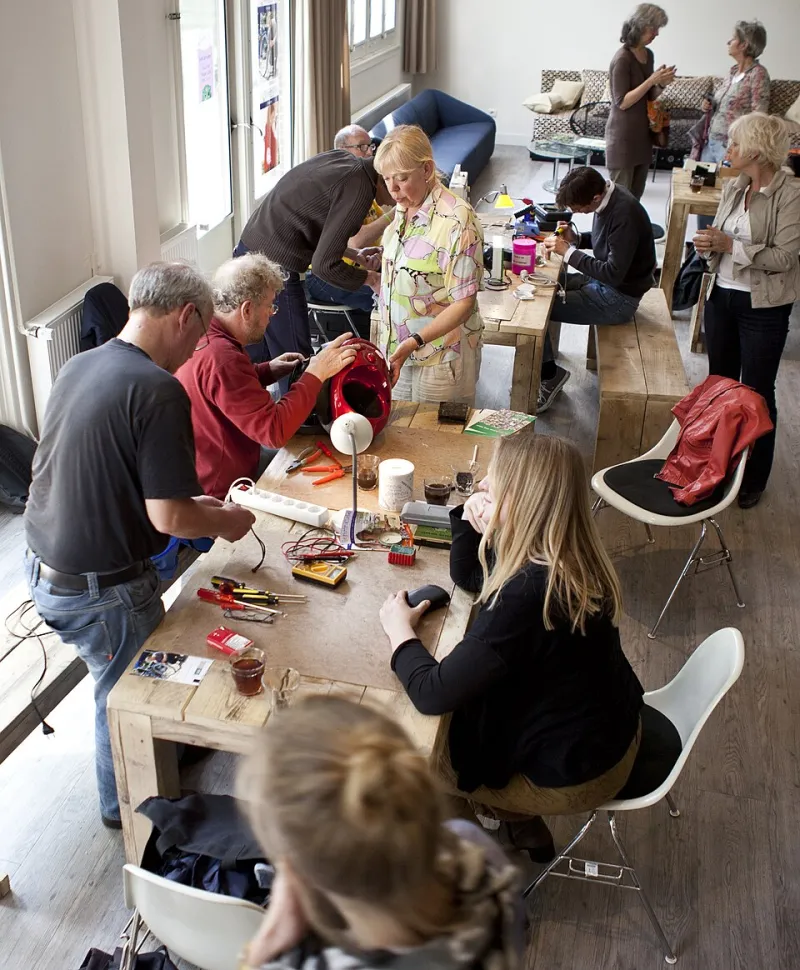
Photo: Ilvy Njiokiktjien, CC BY-SA 3.0, via Wikimedia Commons
The queue
You can hear the repair café before you see it. Not because it's loud — it isn't — but because there is a particular Sunday-morning sound to it: the clink of mugs, the scrape of chairs, the low murmur of people explaining what went wrong.
In a church hall in a Midlands town, a folding table by the door is doing reception. There's a clipboard, a box of biros, and a laminated sign that says 'Please sign in and describe your item'. Behind it, a volunteer in a fleece is sorting a queue that includes a lamp, a radio, a pair of trousers and a toaster.
The toaster is the object I've come to follow. It belongs to Priya, who lives a few streets away. It is a cream-coloured Morphy Richards, bought in 1997, and the lever no longer stays down. She has brought it in a supermarket bag for life, wrapped in a tea towel.
'I know it's not worth much,' she says, apologetically. 'But it makes good toast. And I've had it longer than I've had most of my friends.'
The diagnosis
The toaster lands on a table with a volunteer called Alan, a retired electrical engineer with a head torch and the calm air of a man who has seen worse. He listens to Priya's description, nods, and plugs it in. The lever goes down. Nothing happens. He unplugs it, turns it over, and starts removing screws with the precision of someone who has done this ten thousand times.
'Could be the latch,' he says. 'Could be the element. We'll see.'
Around him, other tables are having their own quiet dramas. A woman is learning how to rewire a plug. A teenager is being shown how to patch a jumper with a needle and a bit of wool. Someone is making tea. Someone else is eating a slice of cake and pretending not to hover.
This is the thing about repair cafés that the name doesn't quite capture. Yes, things get fixed. But the real activity is diagnosis: figuring out what has failed, and whether it can be persuaded to fail less.
The fix
Alan finds the problem in about twelve minutes. A bent spring in the latch mechanism, plus a small city of crumbs in the works. He clears the crumbs with a brush, bends the spring back into shape, and tests the lever. It clicks. It stays down. The element glows orange.
Priya makes a small, delighted noise. Alan looks modestly pleased, the way people do when they've done something useful and don't want to make a fuss.
'That'll be a donation,' says the volunteer at reception. 'Whatever you think it's worth.' Priya puts a fiver in the tin. The toaster goes home in the tea towel.
Why it matters
The first repair café opened in Amsterdam in 2009. Since then, the idea has spread to thousands of groups around the world. In the UK, you'll find them in church halls, libraries, community centres, maker spaces and the back rooms of pubs. Some are monthly. Some are quarterly. All of them run on volunteers, tea, and the radical suggestion that a broken thing might not be rubbish.
That suggestion is more powerful than it sounds. We live in a culture that treats repair as a niche hobby rather than a normal part of ownership. A repair café pushes back against that, one fuse at a time. It also teaches people how things work, which is a quietly political act in a world of sealed units and proprietary screws.
And there is something else: optimism. Not the forced kind, with exclamation marks. The practical kind. The kind that says: bring out your broken things. We'll have a look. We might not fix it. But we'll try.
Find one or start one
If you want to find a repair café, start with the Repair Café Foundation's map and the Restart Project's directory. Local libraries, transition groups and community newsletters are also good places to look. Most groups welcome visitors, even if you're just curious.
If there isn't one near you, starting one is easier than you might think — and harder than you might hope. You need a venue, insurance, a handful of volunteers with different skills, a basic toolkit, and a safe way to test electrical items. You also need patience. The first session might be three people and a kettle. That's fine. Most things start small.
The important thing is to begin. Bring out your broken. Put the kettle on. See what happens.
On the way out, I ask Priya if she'll come back. She looks at the toaster, then at the room. 'I might volunteer,' she says. 'I'm good with a needle.'
Hope, it turns out, is a Sunday morning thing.