The Flowerbed in the Fast Lane: Britain’s Roundabout Gardens and the People Who Tend Them
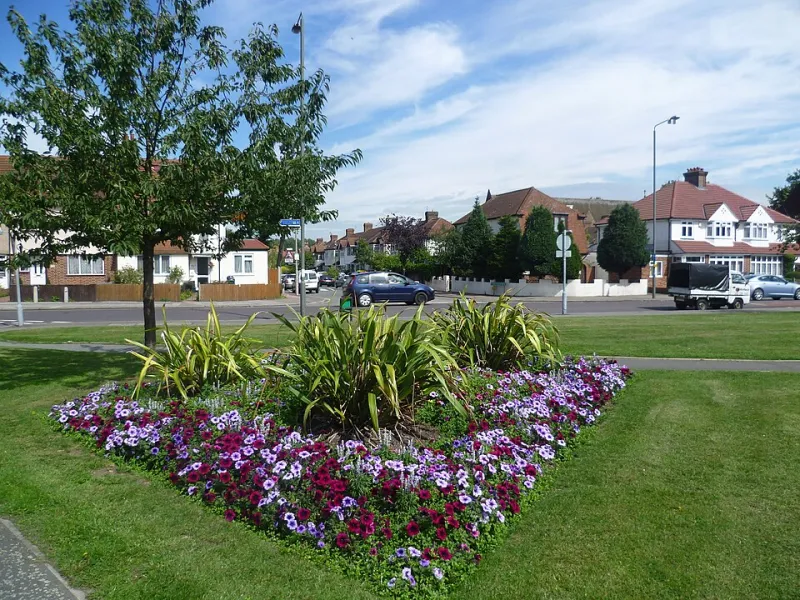
Photo: Marathon , CC BY-SA 2.0, via Wikimedia Commons
There is a particular kind of British gardener who thinks in circles. Not the cottage-border romantic, nor the allotment pragmatist with a seed tin and a grudge against pigeons, but the parks-team planner who can look at a traffic island and see next June. They know that a roundabout is not just a junction. It is a stage, a signpost and, for a few months a year, a very public flowerbed.
The small theatre of the traffic island
You pass them at 30mph, maybe 40 if the dual carriageway allows, and rarely give them a second thought. Yet the roundabout garden is one of the most quietly ambitious things a town does. It has no ticket office, no opening times and no gift shop. It simply appears, usually in late spring, as a geometric arrangement of petunias, geraniums, marigolds and whatever else the bedding scheme has decreed. By August it is a riot. By October it is a tidy brown nothing, waiting for next year's plan.
The craft behind it is older than most of us assume. Municipal bedding displays became a badge of civic pride in the post-war decades, when parks departments competed to produce carpets of colour that could be seen from a moving car. Carpet bedding — those low, mosaic-like patterns of alternating plants — was once a serious art form, taught at horticultural colleges and copied by towns keen to look modern and cared-for. Some of that ambition has gone, but the instinct remains. A roundabout is still one of the few places where a local authority can say something decorative to everybody at once.
Petunias, plans and the people who plant them
The people who keep this going are not usually grand designers. They are parks supervisors, apprentices, seasonal staff and volunteers with a van, a watering bowser and a risk assessment. Planting a roundabout is not like planting a border. You work in short windows, often early in the morning, behind cones and signs. You learn to carry everything you need because the van cannot always stop nearby. You develop a relationship with traffic that is best described as respectful.
Then there are the volunteer groups. Some towns have Friends of groups that adopt a bed or a seafront strip, raising money for plug plants and turning up with trowels on a Saturday. Others rely on Britain in Bloom entrants, who treat a roundabout as a chance to show the judges what the town can do. The results can be charmingly uneven. One junction gets a precise wheel of red and white; another gets a cheerful scramble of whatever was left in the greenhouse. Both are doing the same job.
In 2026, the job is harder than it looks. Council budgets are tight, and parks teams are often small. A flowerbed has to justify itself against potholes and bin collections. That has led to some interesting compromises: more perennial planting, more drought-tolerant species, fewer of the thirsty bedding schemes that once defined the summer. Some roundabouts have been deliberately rewilded, turned over to wildflower seed and left to get on with it. That is not a failure. It is a different kind of civic gardening, and it has its own quiet beauty.
Why the roundabout still earns its keep
So why do the flowered ones still matter? Partly because they are free. Not free to plant, obviously, but free to enjoy. You do not need to book, pay or know anything about horticulture. A roundabout garden is public art with a horticultural brief, and it belongs to everyone who drives past it. It also marks the seasons in a way that a digital calendar cannot. The first geraniums of the year are as reliable a sign of summer as an ice cream van.
There is a wayfinding quality, too. A well-planted roundabout tells you where you are. Seaside towns go for thrift and sea pink; market towns favour something blowsy and generous; city junctions sometimes get a sculptural shrub and a mulch that looks like gravel. These are small clues, but they add up. They make a place feel tended, even if the rest of the high street is looking tired.
And there is the simple fact of care. A roundabout garden is a small statement that somebody thought about the view from your windscreen. In a country that often talks about civic pride in the abstract, here it is in concrete — or rather, in compost. It is not grand. It is not going to solve anything. But it is there, doing its quiet, circular thing.
A slow lap
Next time you approach a roundabout, try not to look at the exit signs. Look at the middle. You might see a parks team's summer project, a volunteer's Saturday morning, or a council's attempt to make a junction feel like a place. You might see petunias at 40mph. You might see nothing but grass and a discarded cone. Either way, it is worth a glance. The roundabout garden is one of Britain's most underrated public spaces, and it is hiding in plain sight.