The Bright Room on the Corner: A Field Guide to Britain’s Launderettes
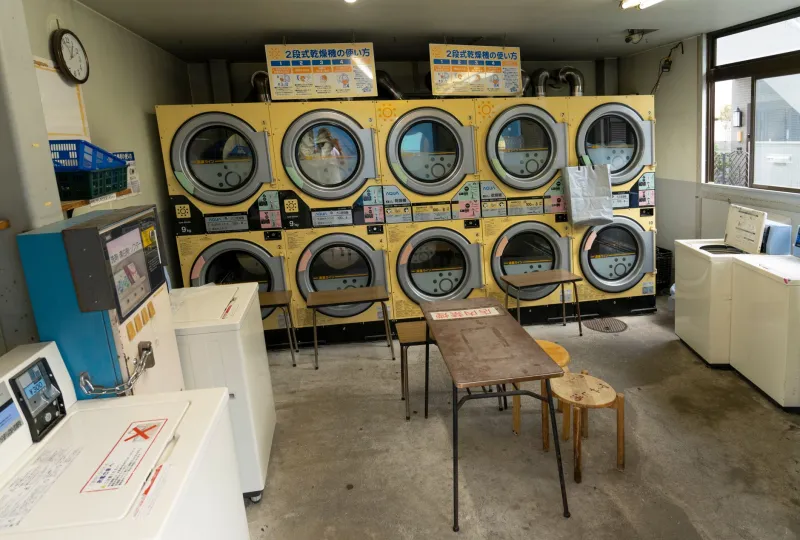
There is a particular kind of British light that only exists inside a launderette. It is fluorescent, slightly too bright, and it falls on plastic chairs, tiled floors and a row of machines turning someone else’s sheets. Step in on a wet Tuesday and you might find a man reading a racing paper, a student hunting for a lost sock, and a woman who has brought her own flask because she knows the service wash takes forty minutes. Nobody planned this gathering. That is exactly the point.
In 2026, when so much of local life has been tidied into apps, bookings and algorithms, the launderette remains pleasantly unoptimised. You turn up. You wait. You talk, or you don’t. The room does the rest.
The unplanned club
Britain’s remaining independent launderettes are not museums pieces, though some feel as if they have been quietly preserved since the 1980s. They are working shops. In seaside towns they handle holiday lets and damp cottages. In cities they serve students, shift workers and people in flats with nowhere to put a washer. In market towns they are the backup plan when the machine at home gives up on a Sunday.
What makes them interesting is not the spin cycle. It is the social physics. A launderette is one of the few places where strangers can comment on each other’s laundry without it being odd. Not in a nosy way, more in the manner of a shared waiting room. Someone will ask if the middle dryer is any good. Someone else will offer a spare tablet. A child will press their face against the glass and announce that the bubbles look like clouds. The etiquette is loose but real: don’t hog the big machine, wipe the surface, and never remove someone else’s washing unless the sign says you may.
What the handwritten signs tell you
Look above the machines and you will find the true literature of the launderette. Signs taped at eye level, some typed, many not. Please do not put dog blankets in with the usual wash. Out of order until Thursday. Service wash last load 4pm. These notices are practical, but they are also a small record of the street: who is in a hurry, who has a dog, who tried to dry a duvet and learned a lesson.
The best ones have a voice. A notice in a Yorkshire launderette once explained, in careful capitals, that the large dryer was taking longer because the weather was damp. It apologised. Where else does a machine’s mood get acknowledged like that? The handwritten sign is a reminder that the place is run by people, not a portal. If you are new to a launderette, read the signs before you feed the coin slot. They will tell you more about the rhythm of the room than any instruction manual.
A field guide for the first visit
Before you go
Sort your load at home. Separate colours, towels and anything that sheds. Bring a bag for the clean washing and a small cloth for spills. Check the opening hours online if you can, but trust the door more than the website. Many independents still close early on Sundays and take a break on bank holidays. Coins are useful, though card machines are increasingly common. A spare pound or two is never wasted.
In the room
Pick a machine that matches your load, not the biggest one simply because it is free. Load loosely. Leave the door open if the machine is finished and you are collecting someone else’s wash only when the staff say so. If you are waiting, choose a seat that does not block the walkway. The unspoken rule is simple: be easy to share a room with.
The service wash
This is the quiet hero of the British launderette. You hand over a bag, pay a set price, and come back later to find your clothes clean, dried and often folded. It is useful for duvets, work uniforms, curtains and anyone without a machine at home. Ask what is included before you hand over anything delicate. Service washes are not a luxury; for plenty of people they are the practical difference between a manageable week and a chaotic one.
Why the bright room still matters
Launderettes are sometimes described as accidental community spaces, which is a slightly grand way of saying they are rooms where people bump into each other. But that is valuable. On a high street of closed banks and click-and-collect points, a launderette gives you a reason to stand still. It is warm. It is lit. It smells of clean cotton and faintly of someone’s fabric conditioner. You can ask a stranger a small question and get a small answer. That is not nothing.
They are also stubbornly local. The prices are set by the owner, not a distant app. The opening hours reflect the street. The noticeboard by the door might advertise a choir, a missing cat or a Saturday car boot sale. In 2026, that feels less like nostalgia and more like a useful civic service with a spin cycle attached.
So next time you pass a launderette and see the machines turning behind the glass, don’t just hurry by. Step in. Read the signs. Wait a while. Britain is in there, tumbling dry.