Fern Weather: The Quiet Pleasure of Britain’s Free Winter Glasshouses
There is a particular kind of November afternoon when the rain stops being weather and starts being a personality. It drums on bus shelters, finds the gap between scarf and collar, and makes the idea of ‘just popping into town’ feel like a minor expedition. This is when I start thinking about glasshouses.
Not the big ticket-and-turnstile kind, though they have their pleasures. I mean the free ones: the municipal palm houses, the park conservatories, the Victorian glass ranges that sit in British public gardens like slightly overgrown sitting rooms. You can walk in, take off your hood, and stay until your fingers remember what they’re for. No one expects you to buy anything. The ferns certainly don’t.
A civic gift with condensation on the windows
Britain’s public glasshouses were not built as shelters for soggy readers. They were statements. In the nineteenth and early twentieth centuries, towns competed to build palm houses and winter gardens as proof of civic ambition — places where working people could encounter plants from elsewhere without leaving town. There was an educational purpose, and a reforming one too: fresh air, respectable leisure, somewhere to go that wasn’t the pub. The architecture was often glorious and occasionally mad. Iron, glass, steam, and a slightly imperial sense of confidence.
Many survived by the skin of their glazing bars. Some were restored with lottery money; others trundle along on volunteer tea stalls and council budgets stretched thinner than a seedling. What remains, in the free ones, is a very specific sort of British generosity: a warm room in a public park, open to anyone, with no obvious commercial point. In a country that increasingly wants you to book, pay or prove you belong, that feels quietly radical.
The art of doing nothing among ferns
The first rule of a winter glasshouse is that you are not there to achieve anything. This is not a co-working space. Your laptop can stay in the bag. The pleasure is in the slowing down: the smell of damp earth, the tick of rain on the roof, the way the windows steam up and turn the outside world into a soft grey smudge.
Regulars understand this. There is a whole unspoken etiquette. Keep your phone quiet. Don’t colonise a bench with three coats and a rucksack. Say hello to the person who is always there with the same paperback. If you bring a flask, bring a lid and don’t leave rings on the slatted wood. Admire the labels, even the Latin ones. And if a toddler has discovered the echo, let them have their moment.
Doing nothing is the point, but it is a busy sort of nothing. You might notice the way the light changes when a cloud passes. You might read four pages and then stare at a fern for ten minutes. You might have a small, unearned thought about how nice it would be to be a person who owns a watering can. This is all permitted.
What to look for, and what to leave alone
A good municipal glasshouse has a few reliable markers: condensation running down the inside of the panes, a faint smell of leaf mould and warm dust, benches that have been sat on for decades, and at least one plant that looks as if it has seen things. Palm houses give you height and drama; smaller conservatories give you intimacy. Both are excellent for a wet afternoon.
The practical rules are simple. Check opening hours before you go — winter hours can be short and occasionally eccentric. Don’t touch the plants, however tempting the citrus. Don’t feed the birds, however charming. If there is a donation box, use it; free is not the same as costless. And if a sign says the glasshouse is closing in ten minutes, believe it.
Five free glasshouses for a wet afternoon
Sefton Park Palm House, Liverpool. An octagonal Victorian stunner with a high glass dome and a proper sense of occasion. Free to enter, with benches, events and a café nearby. Good for a stroll around the park afterwards, even if the rain is horizontal.
Sheffield Botanical Gardens. The glass pavilions here are a joy — elegant, restored, and free. The gardens sit on a slope, so you get the pleasing feeling of having walked somewhere. Winter opening hours vary, so check ahead.
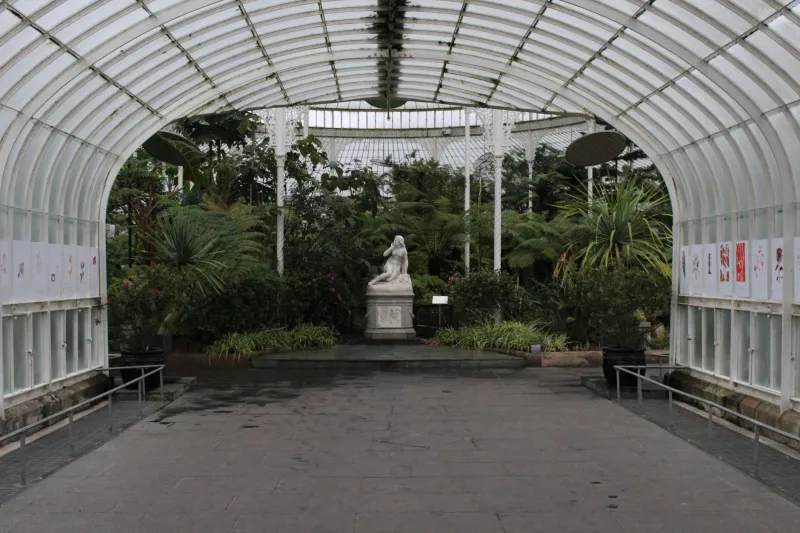
Glasgow Botanic Gardens, Kibble Palace. A Victorian iron-and-glass cathedral of ferns, with benches placed for loitering. Free entry, and the main glasshouse range next door is worth a look too. When it rains in Glasgow, this is where the day improves.
Belfast Botanic Gardens Palm House. A handsome Victorian palm house in a free public park, close to Queen’s University. The kind of place where you can sit with a book and feel briefly academic without doing any work.
Pearson Park Conservatory, Hull. Smaller, municipal, and all the better for it. A proper park conservatory with that slightly scuffed, genuinely public feel. Check opening times; the best things often keep modest hours.
There are dozens more like these scattered around the country — park conservatories, winter gardens, botanical glass ranges — some grand, some gloriously unassuming. The trick is to treat them as what they are: civic rooms for sitting in, not attractions to be ticked off.
The flask question
I am pro-flask. A small thermos of tea, drunk slowly on a bench while the rain hammers the glass, is one of the great underrated British pleasures. But be discreet, take your rubbish home, and don’t turn the bench into a picnic site. If the glasshouse has a café, buy something. If it has a donation box, feed it. Free entry is a gift, and gifts are best kept alive.
And then just sit. Watch the condensation. Listen to the roof. Let the fern do its thing. Outside, November will still be November when you leave. But for an hour, you will have been warm, and nobody will have asked you to be anything other than a person on a bench.