Hallelujah for the Shed: Britain's Tin Churches and Their Glorious Second Acts
There's a particular kind of building that seems to apologise for existing. It sits at the edge of a village, or halfway down a lane, with walls of corrugated iron and a little wooden porch that looks like it was added as an afterthought. It might have a bellcote, or a cross made from two pieces of timber. It is almost certainly painted a colour that was fashionable once, in a decade no one can quite agree on. And it is, more often than not, a tin tabernacle.
These were the flat-pack churches of the late Victorian and Edwardian eras — kits of galvanised iron and timber, sold by catalogue and erected in weeks rather than years. They were cheap, they were quick, and they were everywhere. Mission halls, chapels, Sunday schools, even temporary cathedrals. Hundreds were built across Britain as populations shifted and new suburbs sprawled. Many were meant to last a decade or two. A surprising number are still with us.
The catalogue church
The story goes that you could order a tin tabernacle from a firm in London or Birmingham, and it would arrive by train in pieces, with instructions. Congregations that couldn't afford stone or brick could still have a place to sing. The iron sheets were corrugated for strength and cheapness, and the whole thing could be bolted together by a local builder with a head for puzzles.
What's remarkable is how many survived their intended lifespan. Some are still places of worship. Others have been pressed into service as village halls, storage sheds, studios, workshops, even homes. In Kilburn, north London, a former tin tabernacle has spent years as a community centre and arts space, its iron walls holding decades of noise and goodwill. In rural Wales and the Scottish Highlands, you'll find them tucked into hillsides, their rust streaks mapping the weather. In Norfolk, one serves as a store for a farm. In Ceredigion, another has become a holiday let, of all things.
They are not grand. They are not even particularly beautiful, unless you have a soft spot for the honest and the improvised. But they have a quality that's hard to fake: they were built by people who didn't have much, for a purpose they believed in.
A spotting guide for the curious
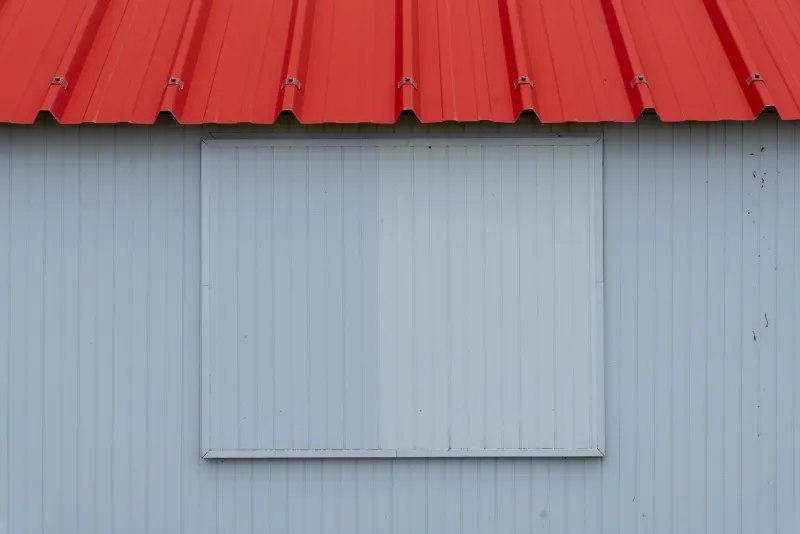
You don't need a specialist's eye to find one. Look for the walls first: vertical corrugated iron, often painted cream, green or a faded maroon. The roof will be the same material, maybe with a slight sag that suggests a century of gravity. Windows are typically narrow and pointed, a nod to Gothic that looks slightly surprised on a shed. Many have a small porch with a pitched roof, and a door that sticks in damp weather. If there's a bellcote, it will be modest — just enough for a single bell, or perhaps just enough to suggest one.
Location is a clue too. Tin tabernacles often sit on awkward plots: a triangle of land at a crossroads, a strip beside a railway, a corner that no one else wanted. They were built where the people were, not where the view was. And they tend to have a graveyard of nettles and a noticeboard with a faded poster for a coffee morning that happened in 2019.
Second lives, quiet and loud
What happens when a congregation dwindles? The building doesn't vanish. It gets sold, or gifted, or simply absorbed into the life of the village. I've heard of one that became a blacksmith's forge, the iron walls ringing with a different kind of hammer. Another is now a recording studio, its peculiar acoustics — dry, close, slightly metallic — prized by folk musicians. A third was converted into a home, the kind of place where the kettle boils on a wood burner and the walls sweat in winter.
These second acts are not always glamorous. Some tin tabernacles are used for storing tractors, or hay, or the village's collection of folding tables. But there's something stubbornly hopeful about a building that refuses to be demolished. It's a reminder that usefulness can outlast original intention.
An argument for keeping them
We are not short of old buildings in Britain. We are, if anything, spoiled for stone churches and listed cottages. But tin tabernacles occupy a different place in the landscape. They are the ecclesiastical equivalent of a shed — modest, practical, a bit wonky. They tell a story about aspiration without grandeur, about faith without fuss. And they are vanishing. Some have been lost to rust, some to redevelopment, some to the simple fact that corrugated iron has a shelf life.
Saving them isn't always straightforward. They aren't usually listed, and repairing them requires a different set of skills from those used to stone. But there are groups doing the work: local trusts, community buyouts, even the occasional sympathetic owner with a tin of hammerite and a free weekend. The best outcomes tend to be the ones where the building keeps serving its community, in whatever form that takes.
So next time you're driving through a village and see a slightly apologetic iron building with a pointed window and a noticeboard, slow down. It might be a workshop, a store, a home, or still a place of worship. It might be empty. But it's part of the fabric of the place, and it's worth a second look. The tin tabernacle was never meant to last forever. That it has is a small, corrugated miracle.