The Vans That Won’t Hibernate: Ice Cream in a British November
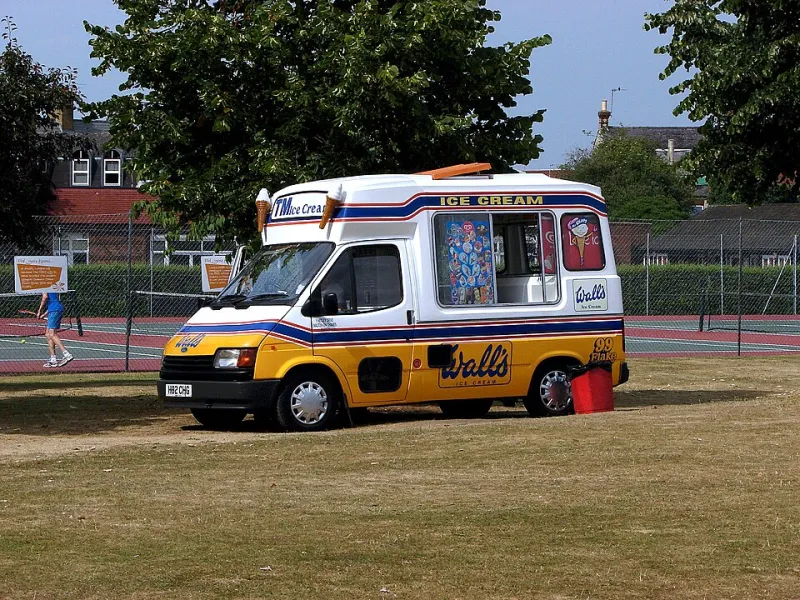
Photo: Alan Hunt , CC BY-SA 2.0, via Wikimedia Commons
On a grey Tuesday morning in early November 2026, a seafront car park on the south coast is doing its best impression of a wet paper bag. The sea is the colour of old cutlery. A dog walker in a cape is wrestling a spaniel. And there, at the far end, is the unmistakable hum of a diesel generator and the soft glow of a serving hatch. An ice cream van. In November. With the menu board out.
This is not a mirage, nor a van that has forgotten to go home. Across Britain, a small number of ice cream sellers trade through the cold months — at seafront car parks, market squares, retail park edges and the odd lay-by with a view of a roundabout. They are not trying to sell you a beach day. They are selling a 99, a hot chocolate, and the mild, cheering absurdity of a cone in the cold.
The holdouts
The winter van is a different creature from its summer cousin. In July, it is one of six vans fighting for a pitch near the promenade, with a queue of sunburnt children and a radio blaring. In November, it is often alone. The hatch opens later, closes earlier, and the menu shrinks. But the core offer remains: soft-serve, flakes, sauces, maybe a tub of Kelly’s if you are lucky. Increasingly, there is also coffee, tea, bacon rolls and soup — the winter van’s survival kit.
The owners I spoke to gave similar reasons for staying open. Some have regulars who expect them: the early-morning swimmers, the dog walkers, the builders on a break, the school run that has become a small ritual. Some have pitches they do not want to lose. Some simply prefer the quiet. ‘Summer is a treadmill,’ one seller told me, wiping down the hatch. ‘Winter is when you get to talk to people.’
Forty cones and a flask of coffee
The economics are not glamorous. A winter day might bring forty customers, not four hundred. The generator still drinks diesel. The pitch fee still lands. The stock still has to be bought. But the costs of closing can be just as real: staff drift away, pitches go to someone else, and a van that disappears in October can be forgotten by Easter.
So the winter van trades on small margins and local habit. It becomes a fixture: the place where the dog gets a sausage, the cyclist gets a flat white, and the toddler gets a baby cone with a flake the size of a matchstick. It is less a business plan than a form of civic stubbornness. And in a country that treats a rainy seafront as a valid day out, that is not nothing.
A field guide to the winter van
Not every parked ice cream van in November is open. Some are hibernating, some are for sale, and some are just a white shape in the mist. Here is how to tell the difference.
- The generator is running. A proper winter van has power, lights and a fridge humming. If it is silent and dark, keep walking.
- There is a hand-written board. ‘Hot chocolate’ and ‘bacon rolls’ are good signs. A laminated ‘99’ sign from July is also promising.
- The hatch is open, but the windows are not. This is a van that knows what it is doing.
- There is a queue of two. One person in a waterproof, one dog. That is a functioning winter pitch.
- The van looks lived-in. Squeeze bottles lined up, a flask on the counter, a cloth tucked into a pocket. This is not a photo opportunity; it is a shift.
How to order without making it weird
First, do not ask if they are open. If the hatch is up, they are open. Second, order something. A 99 is the classic: soft-serve, a chocolate flake, and a sauce of your choosing. If it is genuinely cold, a small cone is more sensible than a large one, and a hot drink is not a betrayal. Third, have cash as well as a card. Some vans are card-only, some are cash-only, and some are whatever the signal allows.
Fourth, eat it there. A cone in the cold is best eaten quickly, with your shoulders up and your back to the wind. Do not ask for extra sprinkles and then take a photograph for four minutes. The ice cream is not the point; the small, defiant pause is.
The last whippy of the year
The winter ice cream van is not a British institution in the way that the seaside pier or the village pub is. It is smaller than that, and easier to miss. But it belongs to the same family of things: the shop that stays open, the bench that is always occupied, the light left on. It says that the season has not entirely shut up shop.
So if you see one this November — at a seafront car park, a market square, the edge of a retail park — buy a 99. Eat it in the rain. Let the flake go slightly soft. It will not change the weather, but it will make the afternoon feel less like a waiting room. And the person in the van will be glad of the custom.