Your Team Name Is Rubbish: In Praise of the Village Hall Quiz
At 7.28 on a Thursday in November, the village hall smells of floor polish, instant coffee and the faint ghost of a jumble sale. A trestle table by the door holds a cash tin, a stack of answer sheets and a raffle prize that appears to be a cheeseboard wrapped in cling film. The quizmaster — a man called Keith, or possibly Alan — taps a biro against a glass and says, 'Right. Phones away. We've had trouble before.' This is not a warning. It is a ritual.
The 2026 winter quiz season is already underway in halls, pub back rooms and working men's clubs across the country. Entry is usually £2. The questions are photocopied. The heating is either off or tropical. And for two hours on a weeknight, a room full of people who would not otherwise share a table sit together, argue gently about the height of a mountain and eat sandwiches cut into triangles. It is one of the last genuinely mixed-room gatherings we have left. It is also, if you choose well, a very good night out.
The rules are approximately rules
Every quiz has a constitution, and every constitution is slightly different. Some have six rounds of ten. Some have eight rounds of eight and a snowball round that nobody can explain. Some deduct a point for a wrong answer; some deduct a point for arguing. The quizmaster's rulings are final, even when they are clearly wrong, and especially when they concern the difference between a biscuit and a cake.
This is not a competition. Or rather, it is a competition in the way that a church fete is a competition: everyone would like to win, but the real business is the taking part, the tea, and the low-level gossip. The team names tell you everything. You will see Quiz Team Aguilera, Norfolk and Chance, The Partially Sighted Scribes and a team called Dave. Someone will have brought a lucky mascot. Someone else will have brought a highlighter. Neither will help.
The picture round is a personality test
The picture round is where the quiz reveals its soul. It is usually a sheet of grey photocopies: minor celebrities, famous bridges, a close-up of a vegetable. The images are often so degraded that the Eiffel Tower looks like a filing cabinet. The quizmaster will say, 'Number four is a bit blurry, but you should get it.' Nobody gets it.
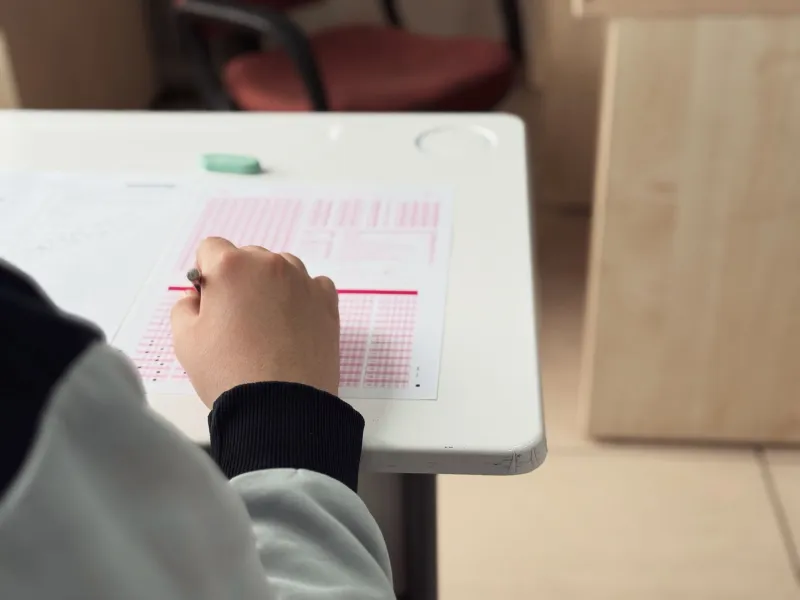
This is the point. The picture round is not really a test of knowledge; it is a test of how your table behaves under mild uncertainty. One person will confidently write down the wrong answer. Another will say, 'It's definitely not that.' A third will remember something from a documentary they watched in 2019 and refuse to let it go. The answer sheet becomes a small map of your team's personality: the guesser, the doubter, the pedant, the person who has given up and is now eating crisps.
Half-time is the main event
At half-time, the quiz pauses and the hall rearranges itself. The urn is switched on. Sandwiches appear — egg and cress, ham, cheese, and a plate of something vegetarian that nobody touches until the vegetarian arrives. There is a raffle. There is always a raffle.
The raffle is drawn by a child who has been handed a bucket of tickets. Nobody quite understands the system. Is the pink strip a winning line? How many tickets were sold? Why is there a separate draw for the bottle of something brown? It does not matter. Fifty pence a guess, proceeds to the roof fund. The prizes are a box of biscuits, a bottle of wine and a cheeseboard. The cheeseboard is the jackpot. I have seen a grown man punch the air for a cheeseboard.
The last properly mixed room in Britain
Look around the room at half-time and you will see something increasingly rare: a genuine mix. The retired head teacher is there, and the farmer, and the teenager who has been dragged along by her mum. There is a couple who moved from London two years ago and are still being gently assessed. There is a man who fixes lawnmowers and knows every answer about steam trains. There is a woman who has lived in the village for forty years and once won the WI jam competition. You would not put this group together for a dinner party. You would not find them in the same algorithm. But here they are, sharing a table and a plate of sausage rolls.
That is the quiet radicalism of the village hall quiz. It is not curated. It is not optimised. It is a room full of people who have agreed to be in the same place at the same time and to find out what happens. In a country that increasingly sorts itself by postcode, income and taste, that is worth something. It is also, frankly, good fun.
How to find a good one this winter
You do not need to live in a village to find one. Pub quizzes are the obvious entry point, but the real action is often in the back rooms: the church hall, the cricket club, the community centre, the working men's club that has a sign saying 'Members and Guests' and a quiz on the second Thursday of the month.
Start with the parish magazine, the library noticeboard and the local Facebook group. Ask in the post office. Look for the signs that a quiz is taken seriously but not too seriously: a tea urn, a raffle, a picture round, a quizmaster with a sense of humour and a clipboard. Avoid the ones with a cash prize and no biscuits. A good quiz should cost about the price of a pint and leave you with the feeling that you have been slightly useful to the roof fund.
Go with a friend, or go alone and join a table. The etiquette is simple: bring a pencil, bring a pound for the raffle, and do not take the picture round personally. If you win, be gracious. If you lose, blame the picture round. If you win the cheeseboard, share it.
The quizmaster will tap his glass again. The last round will be general knowledge, then a tie-breaker about the height of a mountain. The urn will be switched off. Someone will say, 'Same time next month?' And everyone will say yes, because the village hall quiz is not really about knowing things. It is about the half-time sandwiches, the raffle nobody understands and the rare pleasure of sitting in a mixed room with a pencil. Fifty pence a guess. Worth every penny.